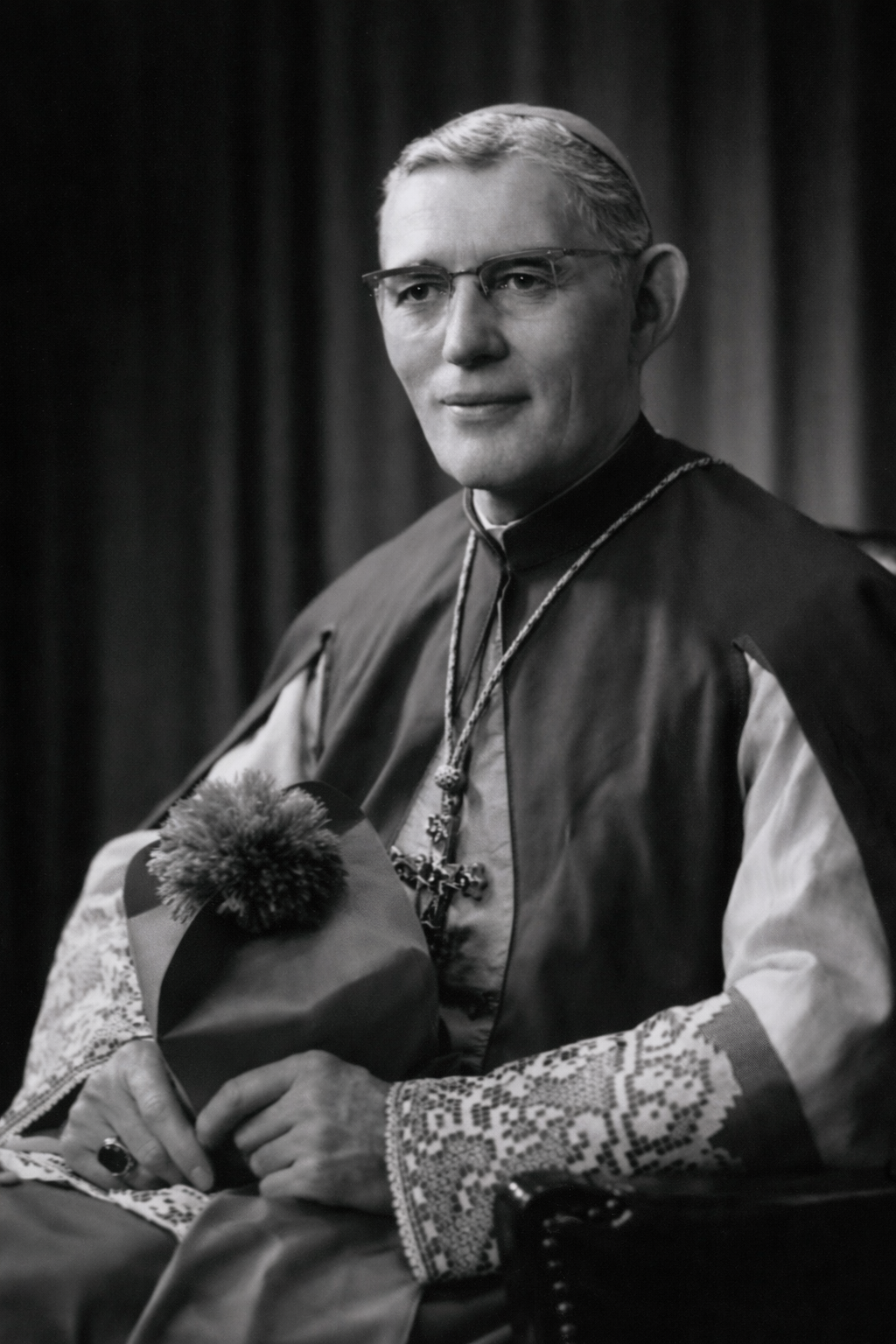
Bishop Vincent J. McCauley, C.S.C.
First Bishop of Fort Portal, Uganda — missionary to three continents and a founding architect of the Church in Eastern Africa.
Quick Facts
First Bishop of Fort Portal · Congregation of Holy Cross
Early Life & Priestly Formation
Vincent Joseph McCauley was born on March 8, 1906, in Council Bluffs, Iowa, the eldest of six children in a devout Catholic family where the daily Rosary was as natural as breathing. Raised with deep faith and fierce determination, he attended Creighton Preparatory School, where he excelled both in the classroom and on the baseball diamond — even playing semi-professionally to help fund his studies.
In November 1924, answering a call he had felt for years, Vincent entered the Congregation of Holy Cross. He professed his perpetual vows on July 2, 1929, earned his degree from the University of Notre Dame in 1930, and was ordained to the priesthood on June 24, 1934, by Bishop John F. Noll at the Basilica of the Sacred Heart.
He bragged he would log 80,000 miles a year to preach missions and raise funds — driven by a burning love for souls.
Accounts of his work as chief fundraiser for Holy Cross Missions
Missionary to Bengal (1936–1944)
On November 16, 1936, Father McCauley arrived in Dhaka. Assigned first to Bandhura, he taught at Holy Cross High School and formed a new generation of catechists. In 1939, he moved deeper into mission territory to evangelize among the Kuki people in the Mymensingh District, where the unforgiving climate struck him with a severe case of malaria that would shadow the rest of his life.
Despite recurring fevers, he was appointed rector of Little Flower Seminary in Bandhura in 1940, devoting himself to shaping the next generation of indigenous priests. When wartime conditions eventually forced his return to the United States, he threw himself into fundraising for Holy Cross Missions — crisscrossing the country, logging tens of thousands of miles annually, and refusing to let physical fragility slow his apostolic fire.
Founding a Mission in Uganda (1958–1961)
In 1958, despite grave health concerns, McCauley was chosen to lead a new Holy Cross mission to Uganda. After three years of remarkable foundational work — building relationships, establishing parishes, and identifying local leaders — he was appointed the first Bishop of Fort Portal by Pope John XXIII. He was consecrated in May 1961 at the University of Notre Dame, a moment of joy for the entire Holy Cross family.
As bishop, McCauley attended all four sessions of the Second Vatican Council (1962–65). The Council’s vision of an inculturated, locally-rooted Church resonated with everything he was already building in western Uganda. He returned from Rome each time with renewed conviction: the Church in Africa had to be authentically African, led by African priests, sisters, and laypeople — not a colonial transplant.
During Uganda’s turbulent post-independence years, Bishop McCauley became a fearless advocate for refugees fleeing violence in Rwanda, the Congo, and Sudan. His gentle yet unwavering manner earned him the trust of both the poor he served and the powerful he challenged. He worked tirelessly to heal tribal wounds within his diocese, seeing in every face the image of God.
AMECEA Leadership & a Church Without Borders
During Vatican II in 1964, Bishop McCauley was elected chairman of the Association of Member Episcopal Conferences in Eastern Africa (AMECEA), a body uniting the Catholic bishops of six nations. Over the next decade, he steered the association through its first three triennial plenary meetings, established the Gaba Pastoral Institute for catechist and lay formation, and laid the foundations for one of the most cohesive regional episcopal bodies on the continent.
From 1972 to 1979, he served as Executive Director of AMECEA in Nairobi, transforming the secretariat into a genuine instrument of ecclesial unity. The late Cardinal Maurice Otunga of Nairobi captured his legacy plainly: “Whatever unity we bishops in Eastern Africa have, we owe it to Bishop McCauley.”
Suffering, Fidelity & a Holy Death
For most of his adult life, Bishop McCauley battled a facial skin cancer that required more than fifty surgical procedures. In September 1976, doctors at the Mayo Clinic inserted a plastic aorta to address the cardiovascular damage wrought by decades of tropical illness and surgery. He bore all of it with characteristic quietness, never allowing suffering to become an excuse for slowing down.
Beginning in July 1982, acute pulmonary hemorrhages forced his return to the United States. He died on November 1, 1982 — the Solemnity of All Saints — while undergoing risky exploratory surgery. He was buried on November 4 in the Holy Cross community cemetery at the University of Notre Dame, surrounded in death by the brothers who had formed and sustained him. At the news of his passing, a fellow missionary spoke for many: “A valiant man of God died, but a saint was born.”
Cause for Beatification & Canonization
In August 2006, the Congregation for the Causes of Saints formally opened the cause for the beatification and canonization of Bishop Vincent J. McCauley, C.S.C. He now holds the title Servant of God. The diocesan phase of investigation has been completed, and the positio — the formal documentation of his life, heroic virtues, and reputation for holiness — has been submitted to the Holy See. The faithful in Uganda, Bangladesh, the United States, and across Eastern Africa continue to seek his intercession, confident that the Church will one day confirm what they have long believed.
A Life Without Borders Iowa → Bengal → Uganda → Eternity
Pray for His Intercession
Bishop McCauley bore the Cross in body and spirit for nearly fifty years — through malaria, cancer, war, and exile. The faithful of Uganda, Bangladesh, and the wider Church continue to seek his intercession, trusting that the holiness witnessed in his life endures before God.